

As an Amazon Associate, I earn from qualifying purchases. This post contains affiliate links, and I may earn a commission at no extra cost to you. All images are for illustrative purposes only, and actual products and services may differ from those shown.
Welcome back to FindWithJ.
One of the greatest advantages of remote work is flexibility, but it comes with a distinct challenge: your office is always just a few feet away. The desk is always there, the laptop is sitting on the table, and the temptation to check just one last email can easily linger well into the evening. To separate time and space at home, it can be helpful to establish a few simple boundaries between work and personal life.
When your living room doubles as your workspace, the physical walls that used to protect your personal time no longer exist. You might find yourself watching television while thinking about a project, or cooking dinner while mentally drafting a response to a coworker. To keep work from slowly taking over my personal life, I have had to set strict, non-negotiable rules regarding both time and space.
The first major boundary revolves around the midday break. It is very easy to fall into the habit of eating a sandwich with one hand while typing a response on a messaging app with the other. In the past, I used to think that working through lunch would help me get more done, but I found that it often had the opposite effect for me. For me, working without a break often made it harder to make decisions and stay focused in the afternoon. My energy would slump around two or three o’clock, and tasks seemed to take much longer than usual.
Now, I make it a strict point to step away from my workspace entirely during lunch. I walk to the kitchen, sit down without my phone, and focus entirely on my meal. Taking a dedicated break to eat in a different room gives me a chance to step away from work, clear my head, and spend some time away from screens. I usually return to my tasks feeling more refreshed and ready to handle the rest of the afternoon.
The second boundary is establishing a definitive log-off time at the end of the day. Without a boss walking past your desk, coworkers leaving the building, or the lights being turned off in an office, it is easy to let the workday stretch from eight hours to ten or twelve. You think to yourself, “I’ll just finish this one thing,” and suddenly two hours have passed.
To combat this tendency, I treat my end-of-day routine with the same respect as a scheduled business meeting with a client. When the clock hits my designated log-off time, I finish my immediate sentence, save my progress, and shut down my computer.
The work will always be there tomorrow, but your evening hours are finite, valuable, and important for maintaining a healthy separation between work and personal time.
To make this mental switch work consistently, physical separation is key. If you are fortunate enough to have a dedicated home office, leaving that room and closing the door at the end of the day provides an excellent visual and physical cue. For me, it creates a clear reminder that the professional day is complete and that I am allowed to step back into my role as a homeowner, partner, or individual. However, many remote workers do not have a separate room and must work from a shared space like a kitchen table or a living room corner. In these situations, small actions can still make a noticeable difference in how you experience your environment.
At the end of the day, I pack up my laptop, put my notebooks in a drawer, and hide my charging cables out of sight. If I leave my laptop sitting open on the dining table, my eyes will naturally drift toward it throughout the evening, reminding me of unfinished tasks or unread messages.
I find that putting these items away reduces the visual reminders of professional obligations, making it easier for me to mentally step away from work. Boundaries do not happen by accident in a work-from-home environment; we have to intentionally design them into our physical surroundings and daily schedules to make it easier to maintain a healthy separation between work and personal time.
Small Tools That May Help Create Clearer Workday Boundaries
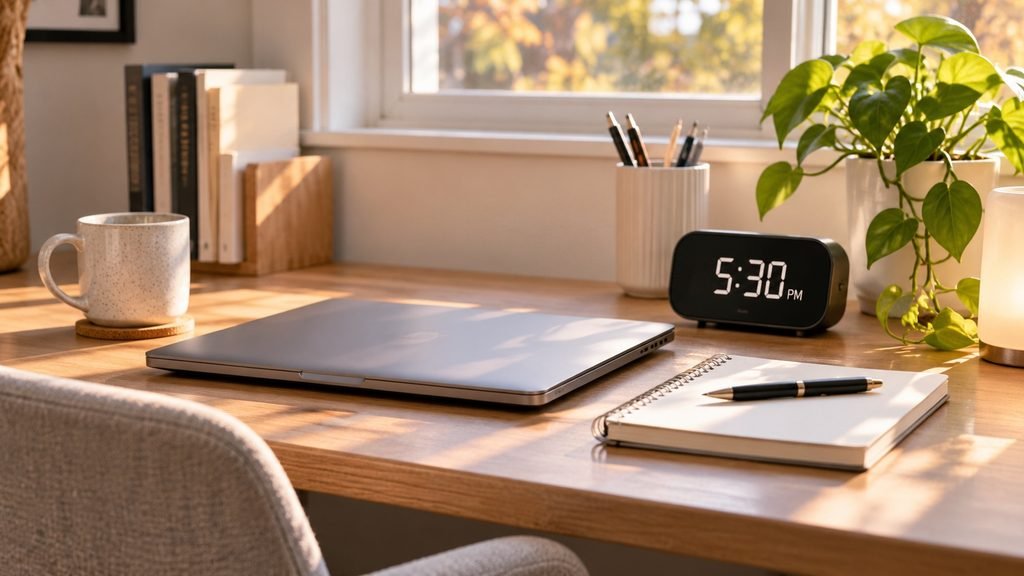
Image for illustrative purposes only
For me, separating work from personal time is mostly about building consistent habits rather than buying more things. Still, a few simple tools may be worth considering if you want clearer reminders of when to take a break or finish your workday.
A clock or reminder placed near a workspace can provide a visual cue without requiring you to check your phone. Depending on how much functionality you prefer, there are several options to consider.
1. Amazon Basics Digital Alarm Clock — Keeping Things Simple
A basic digital alarm clock may be enough for someone who prefers a straightforward way to keep track of time. The Amazon Basics Digital Alarm Clock with Nightlight is one option to consider for a desk or nearby shelf.
For remote workers who tend to lose track of time, having a separate clock in view may serve as a simple reminder to pay attention to lunch breaks and the end of the workday.
👉 Amazon Basics Digital Alarm Clock with Nightlight (paid link)
2. Amazon Echo Show 5 — A More Flexible Reminder Option
For someone who prefers a device with more functions, the Amazon Echo Show 5 offers a different approach. Its display and Alexa features can be used for checking the time and setting alarms or reminders.
A scheduled reminder could be useful for stepping away from the desk at lunchtime or recognizing when the workday is coming to an end.
However, a smart display may not appeal to everyone. If your goal is to reduce digital distractions, a simpler clock might be a better fit.
👉 Amazon Echo Show 5 (paid link)
3. Digital Desk Clock with Temperature and Humidity Display — A Practical Desk Accessory
Another option is a digital desk clock that combines a time display with additional information, such as room temperature and humidity.
This type of clock may appeal to someone who wants an easy-to-read display in a home workspace without relying on a smartphone to check the time.
It is not a substitute for setting personal boundaries, but it can be a practical addition to a desk or shelf where the time remains visible throughout the day.
👉 Digital Desk Clock with Temperature and Humidity Display (paid link)
A Reminder That Tools Are Only Part of the Routine
None of these products is necessary for maintaining a healthy separation between work and personal life. A phone alarm, a calendar reminder, or simply following a consistent schedule can serve a similar purpose.
What matters most to me is following through on the boundaries I have set: stepping away for lunch, closing my laptop at the end of the day, and allowing my home to feel like a personal space again.
The right tool, if I choose to use one, should support those habits rather than add another distraction to my day.